
Search engines are changing, and so is the way people discover information online. Traditional Google searches remain important, but users are increasingly turning to AI-powered tools such as ChatGPT, Google AI Overviews, and other generative search platforms to find quick, relevant answers.
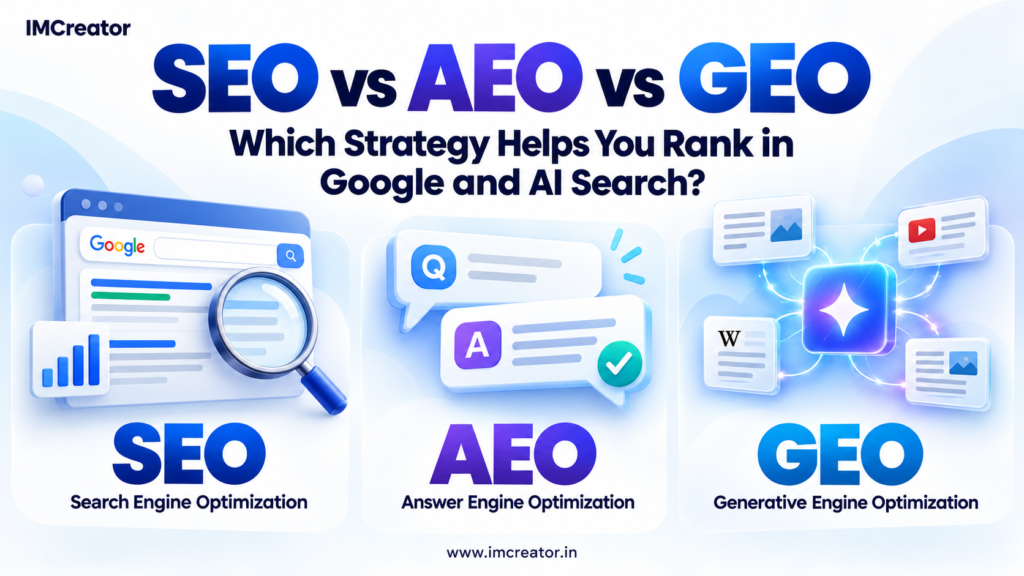
This shift has introduced three important digital marketing strategies: Search Engine Optimization (SEO), Answer Engine Optimization (AEO), and Generative Engine Optimization (GEO).
Although these strategies share a common goal of improving online visibility, each focuses on a different way people search for and consume information. Understanding the differences can help businesses attract organic traffic, appear in AI-generated answers, and build a stronger digital presence.
In this guide, we will explain SEO vs AEO vs GEO, how each strategy works, and which approach can help your business rank in Google and gain visibility across AI search platforms.
What Is SEO (Search Engine Optimization)?
Search Engine Optimization (SEO) is the process of improving a website so that it can appear more prominently in search engine results pages (SERPs). It focuses on helping search engines understand website content and determining how relevant and useful that content is for a particular search query.
SEO remains a core part of digital marketing because people continue to use Google and other search engines to research products, compare services, and find businesses.
Key Elements of SEO
- Keyword research: Identify the search terms your target audience uses.
- On-page SEO: Optimize page titles, meta descriptions, headings, URLs, and content.
- Technical SEO: Improve website speed, mobile usability, indexing, and crawlability.
- Content marketing: Publish relevant, helpful, and original content.
- Link building: Earn quality backlinks that support your website’s authority.
- User experience: Make your website easy to navigate and use.
Example of SEO
Suppose a user searches for “best website design company in India.” A website with relevant content, strong technical performance, helpful service pages, and credible backlinks may have a better chance of appearing in Google’s organic results.
The primary objective of SEO is to improve a website’s visibility in traditional search results and attract relevant organic visitors.
What Is AEO (Answer Engine Optimization)?
Answer Engine Optimization (AEO) focuses on making website content easy for search engines and answer-oriented platforms to understand, extract, and present as a direct answer to a user’s question.
Instead of focusing only on ranking a webpage, AEO also aims to help useful information appear in featured snippets, question-and-answer results, voice search responses, and AI-generated answer experiences.
Key Elements of AEO
- Question-based content: Answer common customer questions directly.
- Clear headings: Use headings that reflect the questions users ask.
- Concise answers: Provide a straightforward response before adding supporting details.
- Structured content: Use lists, tables, and step-by-step explanations where appropriate.
- Structured data: Implement relevant schema markup when it accurately describes the page.
- FAQ content: Address common questions related to your products, services, or industry.
Example of AEO
A user searches, “What is the difference between SEO and AEO?”
A website that provides a clear definition and a concise comparison may be eligible to appear in a featured snippet or another answer-focused search feature, depending on Google’s systems and the query.
AEO helps make content easier to use when a platform needs to provide a direct, reliable answer.
What Is GEO (Generative Engine Optimization)?
Generative Engine Optimization (GEO) is the practice of improving a brand’s chances of being understood, referenced, or cited in responses generated by AI-powered search and conversational tools.
These platforms may combine information from multiple sources to create a response rather than simply displaying a traditional list of blue links.
GEO focuses on making content clear, trustworthy, distinctive, and useful enough to be considered by generative systems. However, appearing in an AI-generated answer is not guaranteed, even when a website follows recommended practices.
Key Elements of GEO
- Original insights: Publish useful information, expert commentary, research, or examples.
- Clear and factual writing: Make important claims easy to understand and verify.
- Topical authority: Build a consistent collection of high-quality content around your area of expertise.
- Credible sources: Support important claims with reliable references.
- Brand consistency: Maintain accurate business information across your website and relevant external platforms.
- Semantic relevance: Cover related concepts, user questions, and context naturally.
- Content accessibility: Ensure search engines can crawl and understand important website content.
Example of GEO
Imagine a user asks an AI tool, “Which digital marketing company can help improve my website’s visibility in Google and AI search?”
An AI system may consider information from different websites, business descriptions, reviews, and other accessible sources when constructing its answer. Clear service descriptions, original expertise, reliable information, and a credible online presence may improve the chances of being considered.
GEO is therefore about improving visibility in AI-generated responses, not simply achieving a higher position in traditional search results.
SEO vs AEO vs GEO: Key Differences
SEO, AEO, and GEO support different aspects of online discovery. They should not be treated as competing strategies because they can work together as part of one digital marketing plan.
| Factor | SEO | AEO | GEO |
|---|---|---|---|
| Full form | Search Engine Optimization | Answer Engine Optimization | Generative Engine Optimization |
| Main goal | Improve visibility in search results | Make content suitable for direct answers | Improve visibility in AI-generated responses |
| Primary focus | Rankings, relevance, and organic traffic | Questions and concise answers | Context, credibility, and useful information |
| Typical platforms | Google Search and Bing | Featured snippets and answer-focused search features | ChatGPT, Google AI experiences, and other generative tools |
| Content approach | Search-intent-driven pages and articles | Direct answers, FAQs, and structured explanations | Original insights, clear context, and credible information |
| Technical priorities | Crawling, indexing, site performance, and structured data | Content clarity and relevant structured data | Crawlability, accessible content, and clear entity information |
| Success measurement | Rankings, clicks, impressions, and organic traffic | Eligible answer appearances, visibility, and referral traffic where measurable | AI mentions, citations, referral visits, and conversions where measurable |
The key difference: SEO helps people discover your pages, AEO helps systems identify direct answers, and GEO focuses on making your content useful and credible for generative AI responses.
Why SEO, AEO, and GEO Matter in 2027
Online search is becoming more varied. Some users browse traditional search results, some look for direct answers, and others ask AI tools to research a topic or compare options.
A business that relies exclusively on traditional keyword rankings may miss opportunities to reach audiences through these additional discovery experiences.
Here is why an integrated strategy matters:
1. Search Behaviour Is Expanding
Users may move between Google Search, AI-generated summaries, and conversational platforms during the same research process. Creating content that serves different search needs can help businesses remain discoverable.
2. Helpful Content Builds Trust
Users need accurate information regardless of how they find it. Content that answers questions clearly, demonstrates genuine expertise, and provides supporting evidence can serve traditional searchers and AI-assisted research alike.
3. Brand Visibility Goes Beyond Rankings
A business can receive value from being discovered through a search result, mentioned in an AI-generated answer, or referenced by another credible website. These are different visibility opportunities and should be measured separately.
4. Search Intent Remains Important
Whether someone searches for a service, asks a question, or requests an AI-generated recommendation, understanding the user’s purpose remains essential. Content should solve the problem behind the query rather than simply repeat keywords.
How to Optimize Your Website for SEO, AEO, and GEO
The most practical approach is to establish strong SEO fundamentals and then improve your content for direct answers and generative search experiences.
Step 1: Research Keywords and Search Intent
Start by identifying the phrases your target audience uses. Include informational searches, commercial queries, comparison keywords, and questions related to your services.
For example, a digital marketing website might target:
- SEO services for small businesses
- How does SEO work?
- SEO vs AEO vs GEO
- How to appear in AI search results
- Benefits of website optimization
Use keyword research tools and search-result analysis to identify relevant opportunities. Choose topics based on audience needs, not search volume alone.
Step 2: Create Helpful, Well-Structured Content
Organize articles with a clear introduction, descriptive headings, short paragraphs, examples, and a useful conclusion.
Answer the main question early in the article. Then provide supporting explanations for readers who need more detail.
Avoid unnecessary repetition, keyword stuffing, and generic content that adds little value.
Step 3: Strengthen Technical SEO
Make sure your website is accessible to search engines and provides a good user experience.
Review the following areas:
- XML sitemap and robots.txt configuration
- Indexing and crawl errors
- Mobile responsiveness
- Page loading performance
- Canonical tags and duplicate content
- HTTPS security
- Internal links and descriptive URLs
- Relevant structured data
These foundations support search visibility and help systems access and interpret your content. No technical change can guarantee inclusion in an AI response.
Step 4: Answer Frequently Asked Questions
Identify questions that prospective customers ask before making a decision. Add clear answers to relevant service pages and blog posts.
For instance, an article about SEO and AI search could answer:
- What is the difference between SEO and GEO?
- Does GEO replace SEO?
- Can a website appear in ChatGPT answers?
- How can a business measure AI search visibility?
Use FAQ sections when they genuinely help readers. Adding FAQ schema does not guarantee a Google FAQ rich result, as Google limits those results largely to well-known government and health websites.
Step 5: Build Credibility With Original Information
Support your content with real experience, accurate data, expert insights, case studies, and relevant examples.
When you publish statistics, cite their sources. Keep business details consistent and make it easy for visitors to understand who created the content and why they should trust it.
Avoid fabricated testimonials, unsupported claims, and publishing the same generic article across multiple pages.
Step 6: Use Structured Data Correctly
Structured data can help search engines understand information about your website, business, articles, products, and other entities.
Depending on the page, relevant schema types may include Organization, Article, BreadcrumbList, and appropriate product or service-related markup.
Always ensure the structured data matches the visible content and follows the relevant platform’s guidelines. Schema markup does not directly guarantee rankings or AI citations.
Step 7: Build Relevant Internal and External Links
Link related blog posts and service pages together so visitors can explore a topic in greater depth. Use descriptive anchor text and maintain a logical website structure.
Earn backlinks through useful resources, original research, expert contributions, and genuine industry relationships. Prioritize relevance and quality instead of purchasing large quantities of low-quality links.
Step 8: Track Traditional and AI Search Performance
Use Google Search Console to monitor search impressions, clicks, click-through rates, and average positions. Use analytics tools to understand engagement, conversions, and referral sources.
For AI visibility, periodically review relevant queries across available AI search platforms. Track brand mentions, citations, referral traffic, and leads where measurement is possible.
AI responses can vary by query, user context, and time, so treat individual checks as directional indicators rather than definitive rankings.
Common Mistakes to Avoid When Optimizing for AI Search
Businesses often make the mistake of treating GEO as a completely separate shortcut to visibility. In reality, many useful practices overlap with established SEO principles.
Avoid these common errors:
- Ignoring technical SEO: Helpful content still needs to be accessible and discoverable.
- Writing only for algorithms: Content should solve real problems for people.
- Stuffing keywords into every heading: Use natural language and cover related topics where relevant.
- Publishing unsupported claims: Verify facts and provide sources for important statements.
- Adding schema without purpose: Use markup only when it accurately describes the page.
- Expecting instant results: Organic search visibility and AI citations can take time and are not guaranteed.
- Measuring only rankings: Consider traffic quality, brand visibility, enquiries, and conversions too.
Which Strategy Should Your Business Choose: SEO, AEO, or GEO?
The right strategy depends on your immediate business goals, but most businesses benefit from combining all three.
Choose SEO as your foundation if you want to improve traditional search visibility, attract organic traffic, and strengthen your website’s technical and content quality.
Prioritize AEO if your audience frequently searches for explanations, comparisons, definitions, and quick answers.
Add GEO practices if you want to improve your chances of being discovered, mentioned, or cited when people use AI-powered search and conversational tools.
For most businesses, the strongest approach is not choosing one strategy over another. It is creating a well-optimized website with useful content that serves traditional search, answer-focused discovery, and AI-assisted research.
Conclusion
SEO, AEO, and GEO represent different but connected approaches to online visibility. SEO focuses on search engine discoverability, AEO emphasizes direct answers, and GEO focuses on visibility within generative AI responses.
As search behaviour continues to evolve, businesses should focus on technical excellence, helpful content, original expertise, and a trustworthy online presence.
The best long-term strategy is to build a website that search engines can access, users can understand, and AI systems can interpret accurately.
Looking to improve your website’s visibility and digital presence? Explore the services offered by IM Creator and identify the website and content improvements that best fit your business goals.
Frequently Asked Questions (FAQs)
1. What is the difference between SEO, AEO, and GEO?
SEO improves visibility in traditional search results. AEO focuses on making information suitable for direct answers, while GEO aims to improve a website’s chances of being referenced in AI-generated responses.
2. Does GEO replace SEO?
No. GEO does not replace SEO. Strong technical SEO, accessible content, useful information, and credible sources remain valuable foundations for online visibility.
3. How can I optimize my website for ChatGPT and AI search?
Publish accurate, original, well-structured content; make key pages accessible to crawlers; build a credible online presence; and answer relevant questions clearly. These practices may improve discoverability, but they cannot guarantee that an AI platform will mention your website.
4. Is AEO important for Google rankings?
AEO can help make content clearer and more useful for answer-oriented search experiences. However, direct answers, featured snippets, and other search features are selected by Google’s systems, and AEO techniques do not guarantee a particular placement.
5. How long does it take to see results from SEO, AEO, and GEO?
There is no fixed timeline. Results depend on factors such as website history, competition, technical issues, content quality, and the search platform. Monitor performance regularly and focus on sustainable improvements rather than guaranteed deadlines.
6. Can small businesses benefit from GEO?
Yes. Small businesses can publish original expertise, detailed service information, useful local content, and trustworthy customer resources. These efforts can support their overall online presence and may improve their chances of appearing in relevant AI-generated responses.
7. How do I measure GEO performance?
Monitor brand mentions and citations in relevant AI responses, referral visits from AI platforms where identifiable, branded search activity, and enquiries. Combine these observations with Google Search Console and website analytics data to understand overall performance.